

By Russell Hartzell, MBA
Sales & Marketing Consultant, Falconer Printing & Design
Quick Summary (TL;DR for Marketing Directors & Office Managers)
-
The Surcharge Shock: A brilliantly designed direct mail envelope can trigger costly postal surcharges, delays, or manual-processing fees if subtle USPS automation guidelines are overlooked.
-
The 3 Common Culprits: Square dimensions (aspect-ratio violations), improper placement inside barcode “clear zones,” and uneven thickness or clasp closures are the primary causes of unexpected postage penalties.
-
Automation Is Where the Savings Live: High-speed postal sorting machines require specific clearances to apply and read Intelligent Mail Barcodes (IMb); designing for automation qualifies mailings for discounted commercial presort rates.
-
In-House Prepress Verification: Falconer Printing evaluates mail pieces during the design phase; performing CASS certification, NCOA scrubbing, automated envelope inserting, and USPS presorting under one roof at 66 E. Main Street. Call 716-665-2504 or visit falconerprinting.com.
When Good Graphic Design Meets Rigid Postal Standards
Nothing deflates a marketing team’s excitement quite like bringing boxes of freshly printed envelopes to the post office, only to hear the postal clerk say:
“These don’t qualify for standard letter rates. You owe a non-machinable surcharge.”
In the commercial print and direct mail world, this scenario happens every single week. A marketing department, freelance designer, or non-profit committee works hard to make an envelope visually distinctive. They select an eye-catching shape, place full-bleed graphics right to the edges, or add a classy metallic closure.
Visually, the piece looks stunning. Mechanically, it fails the United States Postal Service’s automated processing criteria.
USPS optical character readers (OCRs) and barcode sorters process tens of thousands of letters per hour. When an envelope cannot pass smoothly through these belts and rollers, the Postal Service charges a premium to handle it manually. Worse yet, a design error can disqualify an entire bulk mailing from lucrative commercial automation discounts, turning a cost-effective campaign into a budget drain.
Before sending your next billing run, holiday card, or donor appeal to the press, check for these three envelope design pitfalls.
1. The “Square Envelope” Trap: Violating the Aspect Ratio Rule
Square envelopes stand out in a stack of standard #10 business mail, making them a popular choice for wedding stationery, high-end gala invitations, and corporate holiday cards.
However, from the USPS perspective, square mail is non-machinable by definition.
To qualify for automated, standard letter postage rates, an envelope must be rectangular and fall within a specific aspect ratio (length divided by height):
-
Minimum Aspect Ratio: 1.3
-
Maximum Aspect Ratio: 2.5
Aspect Ratio Calculation:
Length (longest dimension) ÷ Height = Aspect Ratio

Example A: Standard #10 Envelope (9.5" × 4.125")
9.5 ÷ 4.125 = 2.30  -->  Machinable (Within 1.3 to 2.5 range)

Example B: Square Invitation (6" × 6")
6.0 ÷ 6.0 = 1.00    -->  Non-Machinable Surcharge Triggered
Because a 6″ × 6″ square piece has an aspect ratio of 1.0 (falling below the 1.3 minimum), high-speed sorting machines cannot properly orient the piece. As a result, every single piece is assessed a non-machinable surcharge, even if it weighs well under one ounce. On a targeted run of 2,500 pieces, an innocent dimensional choice can add hundreds of dollars in unnecessary postage fees alone.
The Fix: If you love the look of an announcement envelope, opt for an A7 envelope (5.25″ × 7.25″) or an A6 envelope (4.75″ × 6.5″). Both provide an upscale, premium greeting-card look while keeping the aspect ratio between 1.36 and 1.38—comfortably inside the machinable standard.
2. Encroaching on the Barcode “Clear Zone”
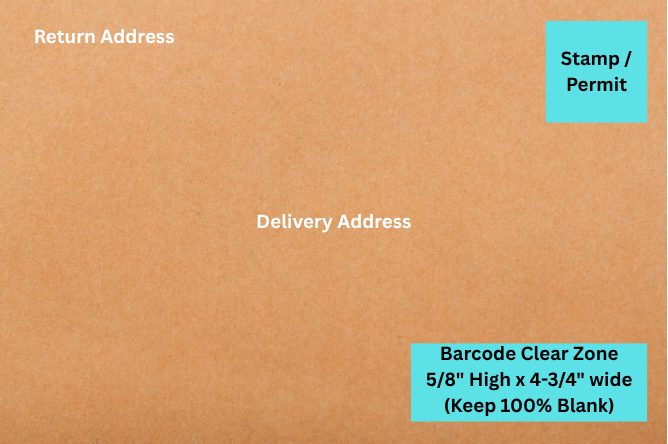
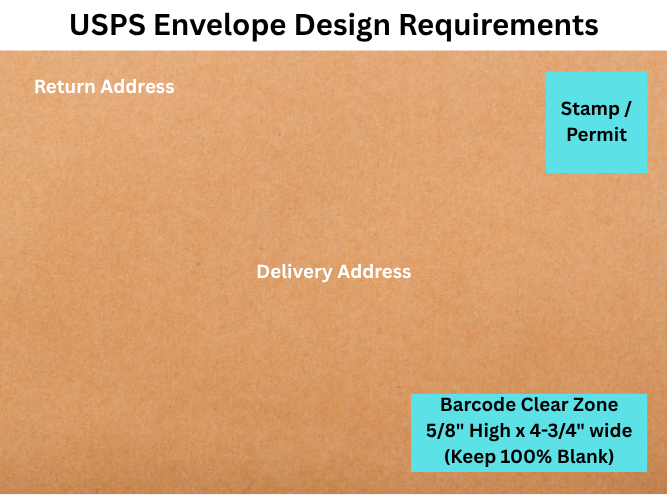
Modern automated mail processing relies on the Intelligent Mail Barcode (IMb), printed either directly above the delivery address or in the lower-right margin of the envelope.
Many creative designers make the mistake of treating the entire face of the envelope as an open canvas, running taglines, brand illustrations, colored background fills, or return addresses across the bottom edge.
When ink, patterns, or logos drift into the Barcode Clear Zone, sorting sensors struggle to read the barcode:
-
The Clear Zone Requirement: The rectangular space measuring 5/8 inch (0.625″) high from the bottom edge, stretching 4-3/4 inches (4.75″) from the right-hand edge, must remain entirely clear of print, dark backgrounds, or busy graphics.
-
Window Envelopes: If you use window envelopes, the address insert inside must have at least 1/8 inch (0.125″) of white space around the address block and barcode at all times—even when the insert shifts inside the envelope during transit.
If your artwork interferes with this scanning area, the automated sorter kicks the piece out of the flow. You lose automation presort discounts and face manual-handling penalties.
The Fix: Work with your commercial print partner during the initial layout stage to apply verified USPS template guides to your design file, ensuring all decorative branding elements stay well clear of the reading zones.
3. Clasp Closures, Rigid Inserts, and Uneven Thickness
A classic kraft envelope with a metal clasp or string-and-button closure might give your company’s product catalog or proposal a vintage, durable aesthetic. Unfortunately, automated sorting equipment views clasps, metal eyelets, and string fasteners as mechanical hazards.
USPS non-machinable criteria clearly state that letters cannot have clasps, strings, buttons, or rigid closures because they snag and tear on sorting belts.
Similarly, issues arise with what goes inside the envelope:
-
The “Lumpy” Envelope: Inserting thick promotional items (such as branded keychains, bulky pens, or thick lapel pins) creates uneven thickness across the face of the envelope.
-
Flexibility Tests: An automated letter must be flexible enough to bend around high-speed cylindrical rollers. If the insert is completely rigid (such as thick plastic tokens or unyielding cardboard backings), it cannot bend, disqualifying it from standard letter rates.
-
Maximum Thickness Disparity: The thickness of a standard machinable letter must be uniform and cannot exceed 1/4 inch (0.25″).
When an envelope contains a rigid clasp or uneven bump, postal machines reject it, and it must be mailed as a “flat” or a “parcel,” categories that carry significantly higher base postage rates.
The Fix: For high-volume marketing and corporate correspondence, stick to moisture-activated gummed flaps or peel-and-seal adhesive closures. If you want to include promotional merchandise, partner with your printer to evaluate lightweight, flat alternatives (like branded tech decals, microfiber cloths, or ultra-thin card tools) that maintain uniform thickness under 0.25 inches.
Machinable vs. Non-Machinable: Cost & Processing Impact
| Envelope Feature | Machinable (Automation-Friendly) | Non-Machinable (Surcharge Risk) |
| Shape & Ratio | Rectangular (Ratio between 1.3 and 2.5) | Square (Ratio < 1.3) or ultra-long (Ratio > 2.5) |
| Lower Right Zone | Clean 5/8″ × 4-3/4″ blank area for barcode | Decorative artwork, dark fills, or copy bleeding to edges |
| Flap Closure | Flat gummed flap or peel-and-seal strip | Metal clasps, string ties, buttons, or thick folds |
| Flexibility & Content | Uniform thickness (≤ 0.25″), fully flexible | Uneven bulges, rigid keychains, or inflexible pens |
| Postage Status | Eligible for bulk presort & automation discounts | Assessed non-machinable retail surcharges or parcel rates |
How In-House Print & Mail Eliminates the Guesswork
The simplest way to protect your marketing budget from surprise postal penalties is to bridge the gap between design and fulfillment before anything runs on a printing press.
At Falconer Printing & Design, our production team does not view printing and mailing as separate disciplines. Because we manage both commercial printing and automated postal fulfillment under one roof at 66 E. Main Street, we review your envelope dimensions, address placement, and paper weights against official USPS specifications before a single sheet of paper is fed through the press.
Our In-House Direct Mail Process Delivers:
-
Prepress Mail Audits: Ensuring your artwork, clear zones, and aspect ratios qualify for lowest-tier automation rates.
-
CASS & NCOA Data Hygiene: Cleansing your recipient list to eliminate bad addresses and returned mail before printing.
-
Variable Data Imaging (VDP): Personalizing recipient information, custom offers, and Intelligent Mail Barcodes in a single clean pass.
-
Automated Machine Inserting & Tabbing: Folding, stuffing, and sealing envelopes mechanically to eliminate costly hand-labor delays.
-
Direct USPS Presort Induction: Barcoding and sorting mail directly for local postal drop-off, passing bulk commercial savings straight back to your organization.
Stop leaving your direct mail budget to chance at the retail postal counter.
-
Visit our shop: 66 E. Main Street, Falconer, NY 14733
-
Call our team: 716-665-2504
-
Request a direct mail quote online: falconerprinting.com/printing/mailing-fulfillment/
